Practices on Contemporary Hydropathy and Orientation: There Is Always a Secret Waterfall
Karolína Voleská & Irene de Boer
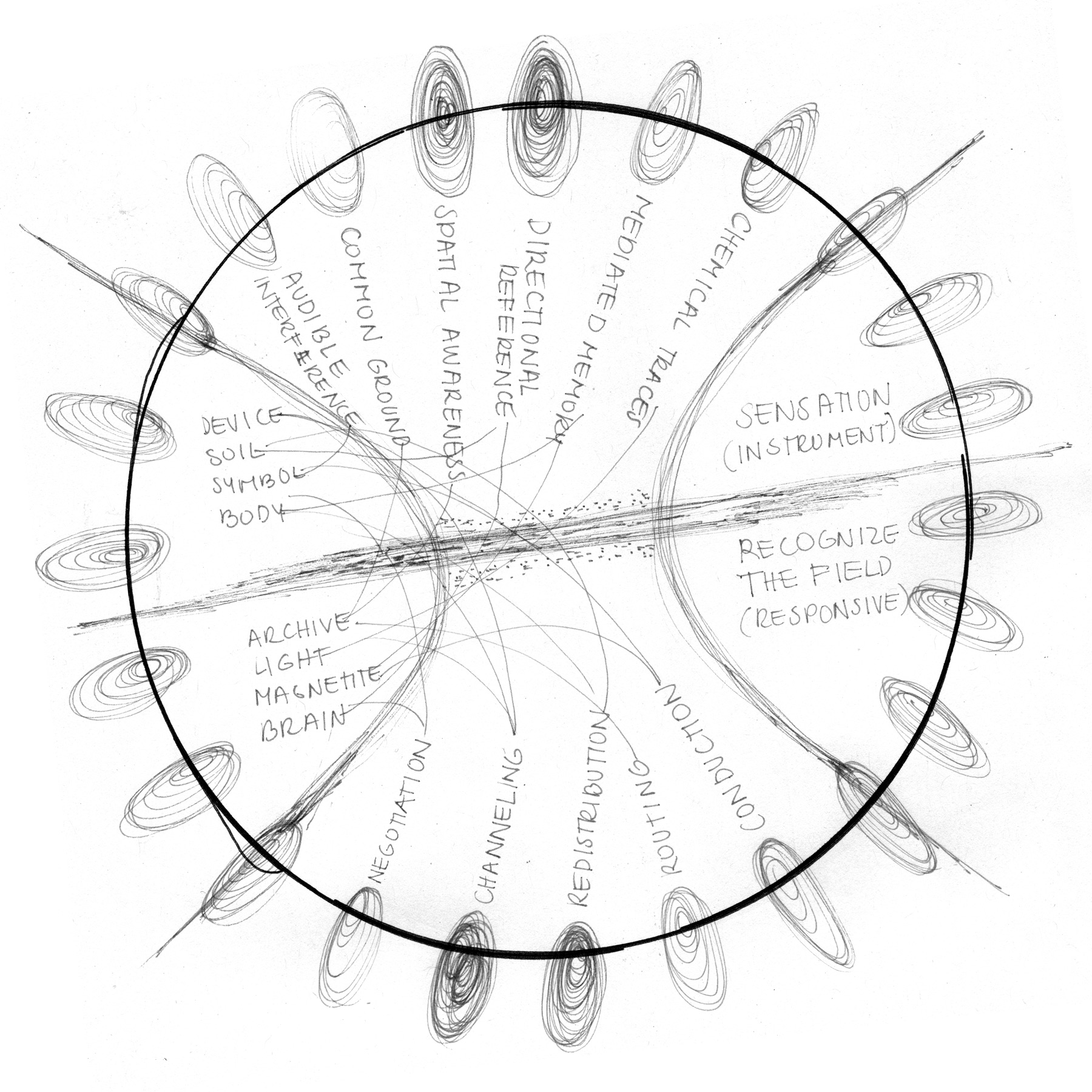
Practices on Contemporary Hydropathy and Orientation: There Is Always a Secret Waterfall is a collective research project that explores the ways in which human and more-than-human bodies orient themselves within environments whose substantial parts remain beyond immediate perception. It begins from the premise that orientation does not have to rely solely on vision, mapping, or the rational reading of space, but can also emerge through sensitivity to flows, vibrations, magnetic fields, chemical traces, sound, and other material processes that continuously pass through bodies, landscapes, and technological infrastructures.
One of the project’s starting perspectives is contemporary hydropathy: a way of thinking through water as a medium of relation, memory, and movement. Water is a medium that, through its circulation and movement, carries minerals, chemical substances, biological matter, and traces of past events. Hydropathic thinking therefore destabilizes the boundary between organism and environment. What exists “outside” can become part of the body and subsequently return to a broader ecological circulation. Within the project, this perspective also draws on hydrofeminist thinking about water as a space of connection between bodies, histories, geographies, and ecosystems. The project loosely builds on John Smedley’s study Practical Hydropathy: Including Plans of Baths and Remarks on Diet, Clothing, and Habits of Life, shifting its premises into new registers through feminist thought.
Water represents a continuous flow, while the project considers the question of orientation within it through the framework of Magnetite Theory. Magnetite exists simultaneously in rocks, technological systems, and living organisms. It is capable of retaining the magnetic memory of the Earth’s field, and its microscopic crystals have been associated with magnetoreception in certain animals; their presence has also been detected in the human body. The project develops this fact speculatively as the possibility of another form of knowledge – an internal compass in which geology becomes part of the organism itself. Orientation, then, does not simply mean knowing where we are, but being capable of sensing the relations and forces in which we are already embedded.
Water and magnetite represent two distinct yet interconnected models of orientation. Water navigates through flow: it searches for a path, moves around obstacles, seeps through surfaces, and connects distant places. Magnetite orients through a field: it responds to a force that is invisible yet omnipresent. One principle is based on movement, the other on attraction and alignment. Between them, a shared field emerges in which fluids, minerals, organisms, and technologies become part of a broader system of planetary perception. The project’s research materials already formulate this connection through conductivity – linking water to electrical current, minerals to magnetism, sound to transmission, and the body to signal. The Earth can thus be understood as an expansive sensorium in which different materials and organisms continuously transmit, receive, and transform information.
At the same time, the project directs attention toward what is present without necessarily being visible. One of its methodological references is diaphonization – a scientific technique that renders the soft tissues of an organism transparent in order to reveal its internal structures. Within the project, it becomes a metaphor for uncovering relationships, systems, and flows that ordinarily remain hidden. Electromagnetic frequencies emitted by electronic devices can be translated into audible sound, sound can be transformed into image, and material or biological processes can become tools for collective perception.
Water runs beneath streets, blood and ions circulate through bodies, electrical currents move through electronic devices, while radio waves and electromagnetic signals travel through the air. Beneath the visible form of the city exist other landscapes shaped by the circulation of matter, energy, and information. Hapjeong itself is approached through this layered perspective: today’s transport, information, and cultural infrastructures overlap with an older landscape once defined by agriculture, streams, and waterways. The medium of movement changes, while the principle of circulation persists.
The exhibition is therefore not conceived as a space for presenting definitive answers, but as a research environment connecting critical thought and visual art. Throughout the project, the installation intersects with a sound studio and with material manifestations of the research through spatial installations, while also being activated by lectures, listening sessions, performances, workshops, collective reading, and informal gatherings. The individual contributions unfold as different practices of visibility: ways of listening to an environment and reading its material traces, while merging into the project’s evolving layers and shifting authorship away from individual positions toward a shared process of collective research.
Practices on Contemporary Hydropathy and Orientation ultimately asks whether contemporary disorientation can also be understood as a problem of sensitivity. Perhaps what we need is not a more accurate map, but different ways of perceiving. Orientation here is not the discovery of a fixed direction, but a practice of attunement – the capacity to register the flows and fields that already pass through us and connect us with the other forms of existence. Somewhere beneath every apparently stable surface, there is always a secret waterfall.